



How to Assess an Ongoing Reform: Experience from the Audit of the State Bureau of Investigation

By Natalia Beskupska, State Auditor, and Leonid Nikiforov, Head of the Division for Control in the Sphere of Law Enforcement Activities, at the Accounting Chamber of Ukraine
In the context of war, Ukraine continues to implement large-scale institutional reforms while simultaneously ensuring the functioning of public authorities and fulfilling its European integration commitments.
Under such circumstances, it is important not only to assess the final results of reforms, but also to identify factors that may affect their implementation. This raised a practical question for the Accounting Chamber of Ukraine (ACU): how can a reform that is still ongoing be assessed objectively?
Instead of applying the traditional in hindsight approach, we designed the audit around an assessment of the institutional framework of the State Bureau of Investigation (SBI) and its ability to achieve the objectives of the reform.
The SBI, established in 2016, is a law enforcement agency responsible for investigating crimes committed by high-ranking officials and law enforcement officers. In 2019, a new stage of its institutional reform began and continues to this day. The full-scale war has significantly changed the operating environment of public institutions and created new challenges for reform implementation.
Assessing the Institutional Framework as the Basis of the Audit
During the audit planning phase, we assumed that the success of a reform depends not only on compliance with established procedures, but also on the existence of the conditions necessary to achieve its strategic objectives.
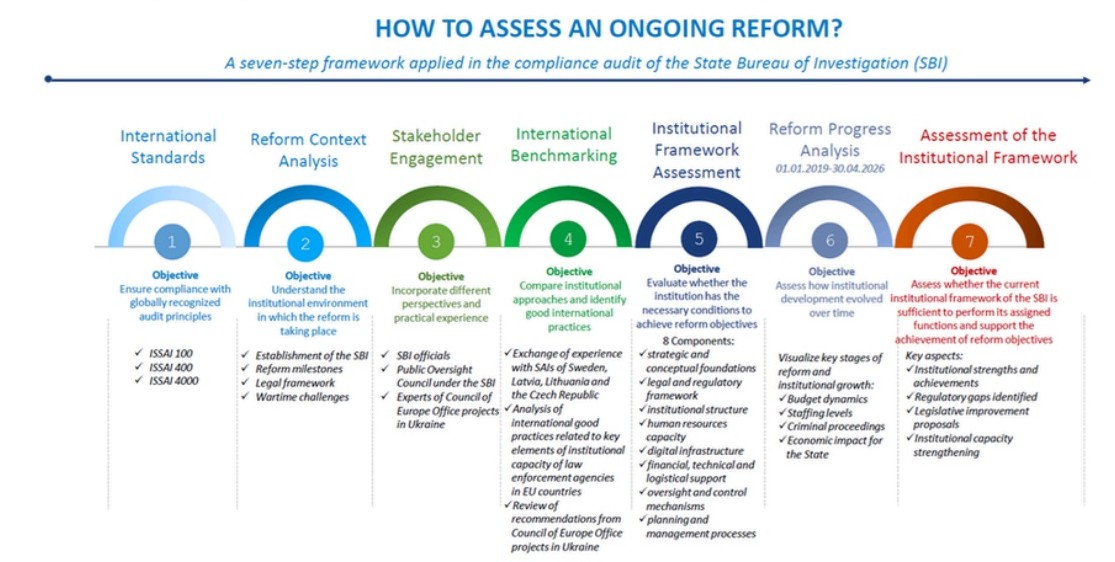
Therefore, we analyzed the key stages of the Bureau’s development, major legislative changes, strategic documents and performance trends, comparing them with the different phases of the institution’s reform process.
Eight key elements were assessed for audit conclusions:
1.strategic and conceptual foundations;
2.legal and regulatory framework;
3.institutional structure;
4.human resources capacity;
5.digital infrastructure;
6.financial, technical and logistical support;
7.oversight and control mechanisms;
8.planning and management processes.
We analyzed each element not only for compliance with legislative requirements, but also for its contribution to the achievement of reform objectives and its alignment with international good practices.
This enabled us to assess the institution’s overall readiness to complete the reform process and effectively perform its assigned functions.
Assessment Tools
To formulate our audit conclusions, we combined several analytical methods. In addition to reviewing the SBI’s legislation, strategic documents, and performance indicators, we consulted with stakeholders and analyzed international experiences regarding the operations of specialized law enforcement agencies.
This approach allowed to take into account different perspectives on the results of the reform, assess the specific features of the SBI’s institutional model within a broader international context, and develop a comprehensive view of the institution’s future development.
Practical Results
It also enabled to assess the reform as a coherent process of institutional change. The audit confirmed that the fundamental legal, organizational, human resource and technological prerequisites necessary for the SBI’s functioning had been established.
At the same time, the comprehensive analysis enabled us to identify regulatory and governance constraints that may affect the further implementation of the reform.
The recommendations were aimed at strengthening the SBI’s capacity and supporting the completion of key stages of its transformation. This approach has provided public authorities and international partners with an independent assessment of the progress made and the challenges that remain in order to successfully complete the reform.
Significance of the Experience
The experience of the Ukrainian SAI demonstrated that compliance auditing can also be used to assess the institutional readiness of public authorities to implement reforms.
When transformation processes span many years and management decisions require timely adjustments, this approach enables SAIs to provide an independent assessment of progress, identify systemic risks, and highlight areas requiring further institutional strengthening.